
The Complete Beginner's Guide to Peptide Research in 2026
Written by NorthPeptide Research Team | Reviewed March 11, 2026
If you have recently discovered the world of research peptides and feel overwhelmed by the sheer volume of information, terminology, and conflicting claims online, you are not alone. The peptide research landscape in 2026 has expanded dramatically from the small community of specialists it was a decade ago, yet accessible, accurate introductions remain surprisingly scarce.
This guide is designed for someone approaching peptide research for the first time. Whether you are a graduate student selecting compounds for your thesis, a laboratory technician expanding your experimental toolkit, or simply a scientifically curious person who has heard about peptides and wants to understand the fundamentals, this article will provide the foundation you need to navigate this field with confidence.
We will cover what peptides actually are at the molecular level, how they differ from conventional drugs and proteins, the current research landscape, how peptides are sourced and handled, and the regulatory framework governing their purchase and use in 2026.
What Are Peptides? The Molecular Basics
A peptide is a short chain of amino acids linked together by peptide bonds — covalent connections formed through a condensation reaction between the carboxyl group of one amino acid and the amino group of the next, with the release of a water molecule. This is the same chemical linkage found in all proteins, because proteins are, fundamentally, very long peptide chains.
The distinction between a peptide and a protein comes down to length. While there is no universally agreed-upon cutoff, the general convention in biochemistry is that chains of approximately 2 to 50 amino acid residues are classified as peptides, while longer chains are considered proteins. For a detailed exploration of where peptides end and proteins begin, see our article on peptides vs proteins: what is the difference?
Why Size Matters
The relatively short length of peptides gives them several properties that distinguish them from larger proteins:
Synthesis: Peptides can be manufactured using solid-phase peptide synthesis (SPPS), a chemical process developed by Bruce Merrifield in 1963. SPPS builds peptide chains one amino acid at a time on a resin support and can produce peptides of up to approximately 50 residues with high purity. Larger proteins generally require biological expression systems — engineered bacteria, yeast, or mammalian cells — rather than chemical synthesis.
Structure: Most peptides do not fold into the complex three-dimensional shapes that proteins adopt. While some peptides form alpha-helices or adopt constrained conformations (especially cyclic peptides), the majority are flexible linear chains in solution. This structural simplicity means peptides typically interact with a single receptor or binding site rather than mediating the complex multi-domain interactions that proteins facilitate.
Bioavailability: Peptides are generally too large for passive cell membrane diffusion (unlike small-molecule drugs) but small enough for relatively efficient absorption after subcutaneous injection. Their intermediate size creates both opportunities and challenges for drug delivery. For more on the chemistry underlying peptide bonds, see our guide to peptide bond chemistry.
How Peptides Differ from Conventional Drugs
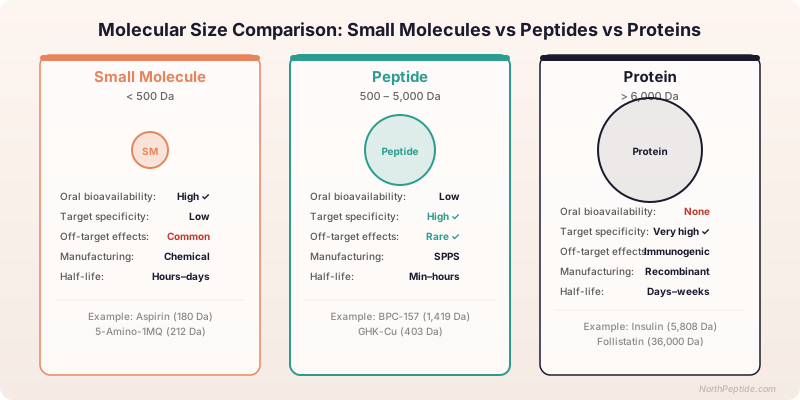
Understanding how research peptides fit into the broader pharmacological landscape requires distinguishing them from the two other major categories of bioactive molecules: small-molecule drugs and large biologic proteins.
Small-Molecule Drugs
Traditional pharmaceuticals like aspirin, metformin, or ibuprofen are small organic molecules, typically weighing under 500 Daltons. They are chemically stable, orally bioavailable, and can cross cell membranes by passive diffusion. Most work by binding to enzyme active sites or receptor pockets through shape complementarity.
Biologic Proteins
On the other end of the spectrum, biologic drugs like monoclonal antibodies (trastuzumab, adalimumab) or recombinant proteins (insulin, erythropoietin) are large molecules weighing 6,000 to 150,000+ Daltons. They offer extraordinary specificity but require refrigerated storage, intravenous or subcutaneous injection, and expensive biological manufacturing systems.
Peptides: The Middle Ground
Research peptides occupy a pharmacological middle ground. Wang et al. (2022) documented that peptide therapeutics combine some advantages of both categories: higher target specificity and lower toxicity than small molecules, with lower manufacturing complexity and better tissue penetration than large biologics. As of 2024, more than 80 peptide drugs had been approved by the FDA, with over 200 in active clinical trials and another 600+ in preclinical development.
| Property | Small Molecules | Peptides | Proteins/Biologics |
|---|---|---|---|
| Molecular Weight | <500 Da | 500–5,000 Da | 6,000–150,000+ Da |
| Oral Bioavailability | Generally high | Generally low (exceptions exist) | Negligible |
| Target Specificity | Moderate | High | Very high |
| Manufacturing | Chemical synthesis | SPPS or recombinant | Biological expression |
| Stability | Generally stable | Moderate (enzymatic degradation) | Low (requires cold chain) |
| Typical Route | Oral | Subcutaneous injection | IV or SC injection |
| Off-Target Effects | Higher risk | Lower risk | Lowest risk |
The Research Peptide Landscape in 2026
The peptide research field has expanded considerably in recent years, driven by advances in synthesis technology, growing interest in targeted therapeutics, and several high-profile regulatory developments. Here is an overview of the major research categories.
Growth Hormone Secretagogues (GHS)
Peptides that stimulate endogenous growth hormone release through the GHS-R1a receptor (ghrelin receptor) or GHRH receptor. Research compounds include Sermorelin, CJC-1295, Ipamorelin, Hexarelin, GHRP-2, and GHRP-6. These peptides are investigated for their effects on growth hormone pulsatility, body composition, and tissue repair pathways.
Recovery and Tissue Repair
Peptides investigated for wound healing, tissue regeneration, and recovery include BPC-157 (notable for its gastric stability and angiogenic properties), TB-500 (Thymosin Beta-4 fragment), and GHK-Cu (copper tripeptide with gene-modulating properties).
Neuropeptides and Nootropics
Peptides targeting the central nervous system include Semax (ACTH analog), Selank (tuftsin analog), and Cerebrolysin (neuropeptide mixture), primarily researched via intranasal delivery for their potential BDNF-modulating and neuroprotective properties.
Metabolic and Weight Management
The GLP-1 receptor agonist class (semaglutide, tirzepatide, retatrutide) has dominated pharmaceutical headlines. Research peptides in this space include AOD-9604 (GH fragment), MOTS-c (mitochondrial-derived peptide), and 5-Amino-1MQ (NNMT inhibitor).
Anti-Aging and Longevity
The bioregulator peptide research tradition, pioneered by Vladimir Khavinson over 40 years, includes short peptides like Epithalon (telomerase activator), Pinealon, and others that are proposed to interact with DNA and histone proteins to modulate gene expression in tissue-specific patterns.
Immune Modulation
Peptides targeting the immune system include Thymosin Alpha-1 (approved in 35+ countries), LL-37 (cathelicidin antimicrobial peptide), and KPV (alpha-MSH fragment with NF-kB inhibitory properties).
How Research Peptides Are Sourced
Research-grade peptides are synthesized using SPPS and are sold as lyophilized (freeze-dried) powder in sealed vials. The sourcing decision is one of the most important choices a researcher makes, as peptide quality directly affects experimental reproducibility.
What to Look for in a Supplier
Certificate of Analysis (COA): Every vial should come with a COA showing HPLC purity (typically ≥98% for research-grade), mass spectrometry confirmation of molecular weight, and ideally amino acid analysis. For a detailed guide to interpreting COAs, see our article on how to read a peptide COA.
Synthesis Method: Fmoc (9-fluorenylmethoxycarbonyl) solid-phase synthesis is the modern standard, having largely replaced the older Boc (tert-butyloxycarbonyl) method. Ask about synthesis methodology if it is not specified.
Purity Tiers: Research-grade peptides typically have ≥95–98% HPLC purity. Pharmaceutical-grade compounds require ≥99% purity plus endotoxin testing and GMP-compliant manufacturing. For a detailed comparison of purity grades, see our article on research-grade vs pharmaceutical-grade peptides.
Storage and Shipping: Lyophilized peptides should be shipped desiccated and stored at -20°C for long-term stability. Suppliers who ship in temperature-controlled packaging demonstrate commitment to product integrity.
How to Handle Research Peptides
Proper peptide handling is fundamental to experimental success. Even high-purity peptides will produce unreliable data if improperly stored, reconstituted, or administered.
Storage
Lyophilized (unreconstituted) peptides should be stored at -20°C in their original sealed vials, protected from light and moisture. Under these conditions, most peptides maintain stability for 12–24 months or longer. Once reconstituted with bacteriostatic water, peptide solutions should be refrigerated at 2–8°C and used within 4–6 weeks depending on the specific compound. For comprehensive storage guidance, see our guide on how to store peptides properly.
Reconstitution
Most research peptides are supplied as lyophilized powder and must be reconstituted with bacteriostatic water (0.9% benzyl alcohol) before use. The process involves adding water slowly along the vial wall to avoid denaturing the peptide through excessive agitation. Swirling — never shaking — distributes the peptide evenly. Our complete reconstitution guide provides step-by-step instructions including volume calculations.
Dosing Calculations
After reconstitution, the peptide concentration depends on the amount of solvent added. For example, reconstituting a 5 mg vial with 2 mL of bacteriostatic water produces a concentration of 2.5 mg/mL (or 2,500 mcg/mL). Researchers then use insulin syringes calibrated in units (1 mL = 100 units) to measure precise volumes for injection.
Degradation Awareness
Peptides are susceptible to several degradation pathways including oxidation (particularly methionine, cysteine, and tryptophan residues), deamidation (asparagine via succinimide intermediate), hydrolysis, aggregation, and racemization. Understanding these pathways helps researchers recognize when a peptide solution may have degraded, producing unreliable results. For more on degradation mechanisms, see our article on peptide stability and degradation.
The Regulatory Landscape in 2026
The legal and regulatory framework surrounding research peptides is evolving rapidly, and understanding current rules is essential for any researcher entering the field.
Research Use Only (RUO) Classification
Research peptides are sold under a "Research Use Only" (RUO) designation, meaning they have not been submitted to or approved by the FDA for any therapeutic use. This classification allows their legal purchase for legitimate scientific investigation — in vitro studies, cell culture experiments, animal model research, and other non-clinical applications.
Critically, RUO peptides cannot legally be used for human or veterinary therapeutic purposes. They are not pharmaceutical-grade products and have not undergone the clinical trial process required for FDA drug approval.
FDA Category 2 and Recent Developments
In 2024, the FDA placed several peptides — including BPC-157, Thymosin Alpha-1, and others — on the Category 2 list, which effectively prevents compounding pharmacies from producing these compounds for patient use. This regulatory action does not affect the purchase of research-grade peptides for laboratory use, but it has significantly impacted the compounding pharmacy sector.
In early 2026, RFK Jr. announced on the Joe Rogan podcast that 14 of the 19 restricted peptides would be moved out of Category 2, potentially restoring compounding pharmacy access. The SAFE Act (H.R. 6509 / S. 3794) introduced in Congress would further protect researcher and patient access to peptide compounds. For comprehensive coverage of these developments, see our 2026 peptide legality guide.
State-Level Variation
Regulations vary by state. Some states have enacted additional restrictions on peptide sales, while others have passed laws protecting compounding pharmacy access. Researchers should verify their state's specific regulations regarding peptide purchase and use.
Getting Started: A Practical Checklist
For researchers new to peptide work, here is a practical checklist for getting started:
1. Define your research question. What biological process are you investigating? This determines which peptide(s) and delivery route(s) are appropriate.
2. Review the literature. Search PubMed and PMC for published studies on your compound of interest. Note the concentrations, routes of administration, and experimental models used in prior research.
3. Select a reputable supplier. Prioritize suppliers that provide third-party COAs with HPLC purity data and mass spectrometry confirmation. NorthPeptide supplies research-grade peptides; published lab results, where they exist for a compound, are listed on our test results page along with the party that commissioned each one.
4. Verify the COA. Check that the molecular weight matches the expected value, HPLC purity is ≥95%, and the lot number on the COA matches the vial label.
5. Plan storage and handling. Ensure you have appropriate storage at -20°C, bacteriostatic water for reconstitution, and insulin syringes for precise dosing.
6. Understand the regulatory framework. Confirm that your intended use falls within the RUO classification for research peptides in your jurisdiction.
7. Document everything. Maintain detailed records of peptide lot numbers, reconstitution dates, storage conditions, and usage — standard laboratory practice that ensures reproducibility.
Common Beginner Mistakes to Avoid
Based on common questions in the research community, here are frequent mistakes to watch for:
Shaking reconstituted peptides. Vigorous shaking can cause peptide aggregation and denaturation. Always swirl gently.
Using regular water for reconstitution. Sterile water without bacteriostatic agents allows microbial growth. Use bacteriostatic water (0.9% benzyl alcohol) for multi-dose vials.
Storing reconstituted peptides at room temperature. Reconstituted solutions degrade rapidly at room temperature. Refrigerate immediately at 2–8°C.
Ignoring the COA. A vial without a COA, or with suspiciously high purity claims (99.99%), should raise questions about supplier reliability.
Mixing peptides without understanding compatibility. Some peptides may interact in solution. Research compatibility before combining compounds in the same vial. For more on multi-peptide protocols, see our article on why researchers combine peptides.
Where to Go from Here
This guide provides the foundation. To deepen your knowledge, we recommend exploring the following NorthPeptide resources based on your area of interest:
Chemistry fundamentals: Peptide Bonds Chemistry Basics and Peptides vs Proteins
Practical skills: How to Reconstitute Peptides, How to Store Peptides Properly, and How to Read a Peptide COA
Quality assurance: Peptide Purity Testing: HPLC and Mass Spec and Research-Grade vs Pharmaceutical-Grade
Regulatory landscape: Peptide Legality Guide 2026
The peptide research field rewards methodical, well-informed investigators. By mastering the basics covered in this guide, you will be well-positioned to design rigorous experiments and contribute meaningful data to this rapidly evolving field.
Products mentioned in this article:
Related Articles
Summary of Key Research References
| Study | Year | Type | Focus | Reference |
|---|---|---|---|---|
| Wang et al. | 2022 | Review | Therapeutic peptides: applications and future directions | PMC8844085 |
| Lee et al. | 2019 | Review | Comprehensive review of peptide drug development | PMC6566176 |
| Rossino et al. | 2023 | Review | Peptides as therapeutic agents: challenges and opportunities | PMC10609221 |
| Almeida | 2024 | Review | The century-long journey of peptide-based drugs | PMC10967573 |
| Vrbnjak & Sewduth | 2024 | Review | Novel strategies in peptide drug discovery | PMC11597556 |
| Zhang et al. | 2020 | Review | Prevalence of peptide therapeutic products | PMC10655677 |
| Renukuntla et al. | 2013 | Review | Enhancing oral bioavailability of peptides | PMC3680128 |
| Seiwerth et al. | 2021 | Review | BPC-157 stability and wound healing | PMC8275860 |
| Khavinson et al. | 2021 | Systematic Review | Peptide regulation of gene expression | PMC8619776 |
Written by NorthPeptide Research Team
Ready to explore research-grade peptides?
Research Disclaimer
For laboratory and research use only. Not for human consumption.
This article is intended solely as a summary of published scientific research. It does not constitute medical advice, treatment recommendations, or an endorsement for any therapeutic purpose. The research discussed herein is predominantly preclinical, and results may not translate to human outcomes. Researchers should consult relevant institutional review boards and regulatory guidelines before designing studies involving these compounds.
NorthPeptide supplies research-grade peptides for legitimate scientific investigation. All products are sold strictly for laboratory and research purposes.