
The Researcher's Guide to Peptide Bonds: Chemistry Basics Explained
Written by NorthPeptide Research Team | Reviewed March 2, 2026
If you work with peptides in any research capacity, you are working with peptide bonds. They are the chemical glue holding every peptide and protein together — the covalent links between amino acids that make biology possible. Yet many researchers use peptides daily without fully understanding the chemistry that holds them together, how that chemistry dictates molecular structure, or why it matters for their experiments.
This guide covers the fundamentals of peptide bond chemistry from the ground up. Think of it as the chemistry primer you wish you had gotten in your first semester of biochemistry: clear, thorough, and focused on the principles that actually matter when you are working with research peptides.
The Condensation Reaction: How Peptide Bonds Form
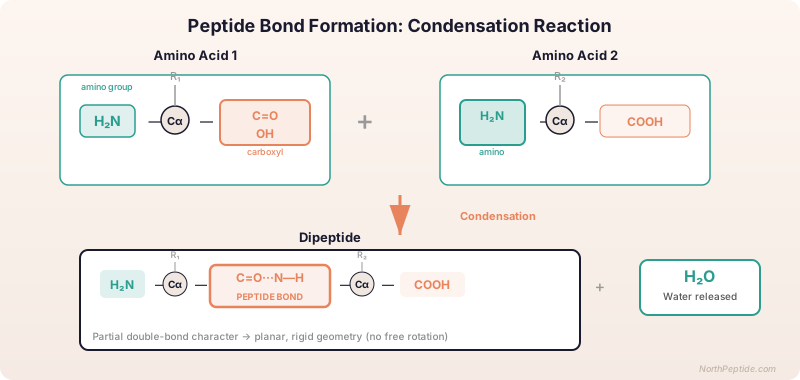
A peptide bond forms when the carboxyl group (–COOH) of one amino acid reacts with the amino group (–NH2) of another. This reaction releases a molecule of water (H2O) and creates a covalent amide bond between the two residues:
Amino Acid 1–COOH + H2N–Amino Acid 2 → Amino Acid 1–CO–NH–Amino Acid 2 + H2O
This is a condensation reaction (also called a dehydration synthesis) because water is a byproduct. The reverse reaction — breaking the peptide bond by adding water — is called hydrolysis. Proteases and peptidases in biological systems catalyze hydrolysis to break down peptides and proteins.
In living cells, peptide bond formation does not happen spontaneously between free amino acids. The reaction is thermodynamically unfavorable under physiological conditions (ΔG°’ is positive). Instead, ribosomes catalyze peptide bond formation during translation, using aminoacyl-tRNA substrates where the amino acids are already activated — the energetic cost has been paid upfront by ATP during tRNA charging.
In the laboratory, chemical peptide synthesis also requires activation. The carboxyl group of the incoming amino acid must be "activated" by coupling reagents (such as HBTU, HATU, or DIC/HOBt) that make it reactive enough to attack the free amino group. This activation step is essential in solid-phase peptide synthesis (SPPS), the standard method for producing research-grade peptides.
The Peptide Bond Is Planar: Why This Matters
Here is the single most important structural fact about the peptide bond: it is planar. The six atoms involved in the peptide bond unit — Cα1, C(=O), O, N, H, and Cα2 — all lie approximately in the same plane.
This planarity arises from partial double bond character. The lone pair of electrons on the nitrogen atom delocalizes into the carbonyl (C=O) system, creating a resonance structure where the C–N bond has roughly 40% double bond character. This resonance:
- Restricts rotation around the C–N bond (the omega angle, ω)
- Shortens the C–N bond from a typical single bond length of ~1.47 Å to ~1.33 Å
- Lengthens the C=O bond from a typical double bond of ~1.20 Å to ~1.24 Å
- Forces the peptide unit into one of two configurations: trans (ω ≈ 180°, where successive Cα atoms are on opposite sides) or cis (ω ≈ 0°, where they are on the same side)
In the vast majority of peptide bonds (~99.95%), the trans configuration is preferred because it minimizes steric clash between the side chains. The cis configuration is rare, occurring almost exclusively before proline residues, where the cyclic side chain reduces the energy penalty for the cis arrangement.
Why does planarity matter for researchers? Because it constrains the backbone geometry of every peptide and protein. The only freely rotating bonds in the peptide backbone are the phi (φ) angle (rotation around the N–Cα bond) and the psi (ψ) angle (rotation around the Cα–C bond). These two dihedral angles, combined with the fixed ω angle, determine all possible backbone conformations — a concept visualized in the Ramachandran plot, which maps the allowed regions of φ/ψ space.
From Sequence to Shape: The Four Levels of Structure
Peptide bonds are the foundation upon which all higher-order molecular structure is built. Understanding how peptide bond chemistry scales from a single bond to a functional molecule requires walking through the four hierarchical levels of protein/peptide structure.
Primary Structure: The Amino Acid Sequence
Primary structure is simply the linear sequence of amino acids connected by peptide bonds, read from the N-terminus (free amino group) to the C-terminus (free carboxyl group). This is the information encoded in DNA and the starting point for understanding any peptide or protein.
The primary structure determines everything that follows. Change one amino acid, and you may alter the molecule’s folding, stability, activity, or receptor binding. This is why peptide purity — confirmed by HPLC and mass spectrometry — is so critical: deletion sequences, truncations, or amino acid substitutions during synthesis can produce a peptide with the wrong primary structure and, consequently, the wrong biological behavior.
Secondary Structure: Local Folding Patterns
When a peptide chain is long enough, regular patterns of hydrogen bonding between backbone atoms create repeating structural motifs. The hydrogen bond donors are the backbone N–H groups; the acceptors are the backbone C=O groups. The two major secondary structures are:
Alpha Helices
The polypeptide chain coils into a right-handed spiral with 3.6 residues per turn. Each backbone C=O forms a hydrogen bond with the N–H four residues ahead. The helix is stabilized by the regularity of these i → i+4 hydrogen bonds and has a characteristic dipole moment (positive at the N-terminus, negative at the C-terminus).
Alpha helices are common in longer peptides and proteins. Certain amino acids favor helix formation (alanine, leucine, methionine), while others disfavor it (proline, glycine). The alpha helix is found in many biologically important peptides, including the transmembrane segments of membrane proteins and the coiled-coil domains of structural proteins.
Beta Sheets
Segments of the chain align side by side, either in the same direction (parallel) or opposite directions (antiparallel), connected by hydrogen bonds between the strands. Beta sheets create a pleated, zigzag arrangement with side chains alternating above and below the sheet plane.
Antiparallel beta sheets are slightly more stable than parallel ones because the hydrogen bonds are more linear (and therefore stronger). Beta sheets are prevalent in proteins like silk fibroin, immunoglobulins, and amyloid fibrils.
Turns and Loops
Beta turns (reverse turns) are short segments (typically 4 residues) that reverse the chain direction, often connecting two strands of a beta sheet. Type I and Type II beta turns differ in the phi/psi angles of the second and third residues. Loops are longer, irregular segments that do not conform to helix or sheet geometry but are often functionally important — many enzyme active sites and receptor-binding regions are located in loops.
Tertiary Structure: The 3D Shape
Tertiary structure describes the overall three-dimensional arrangement of all atoms in a single polypeptide chain. While secondary structure is driven by backbone hydrogen bonds, tertiary structure is determined by interactions between the side chains:
- Hydrophobic interactions — Nonpolar side chains cluster together in the protein interior, away from water. This "hydrophobic core" is often the primary driving force for folding.
- Electrostatic interactions — Salt bridges between oppositely charged side chains (e.g., lysine and glutamate) stabilize specific conformations.
- Hydrogen bonds — Between polar side chains, in addition to the backbone hydrogen bonds of secondary structure.
- Van der Waals forces — Weak but numerous; important for close-packed protein interiors.
- Disulfide bonds — Covalent links between cysteine side chains (see below).
Most short peptides (under ~15 residues) do not adopt stable tertiary structures in solution. They remain flexible, sampling many conformations. Longer peptides and proteins, however, fold into defined shapes that are essential for their function.
Quaternary Structure: Multi-Chain Assemblies
When multiple folded polypeptide chains (subunits) associate to form a functional complex, the arrangement is called quaternary structure. Classic examples include hemoglobin (four subunits), antibodies (four chains), and collagen (three chains in a triple helix). Quaternary structure is stabilized by the same non-covalent forces that drive tertiary folding, plus occasional inter-chain disulfide bonds.
Most research peptides do not exhibit quaternary structure — this is predominantly a feature of larger proteins.
Disulfide Bridges: Covalent Cross-Links That Shape Peptides
Among all the forces stabilizing peptide and protein structure, disulfide bonds deserve special attention because they are covalent — much stronger than the non-covalent interactions described above. A disulfide bond (also called a disulfide bridge) forms when two cysteine residues are oxidized, linking their sulfhydryl (–SH) side chains into a –S–S– bond.
Disulfide bonds serve several important functions:
- Structural stabilization — By covalently linking parts of the chain that may be far apart in the primary sequence, disulfide bonds "lock" the molecule into specific conformations. This dramatically increases thermodynamic stability.
- Proteolytic resistance — Disulfide-constrained peptides are often more resistant to enzymatic degradation because the cross-link prevents the chain from unfolding into a protease-accessible conformation.
- Functional specificity — Many bioactive peptides require specific disulfide bond patterns for activity. Insulin, for example, has three disulfide bonds (two inter-chain, one intra-chain) that are essential for its structure and function.
In the laboratory, disulfide bond formation can be controlled during synthesis through orthogonal protecting group strategies, allowing researchers to form specific disulfide pairs in peptides containing multiple cysteine residues. This is a technically demanding aspect of peptide chemistry that directly impacts product quality — an incorrectly paired disulfide can yield a misfolded, inactive peptide.
Cyclization: Closing the Loop
Cyclization — connecting the two ends or specific side chains of a peptide to form a ring — is one of the most powerful tools in peptide chemistry. Cyclic peptides generally exhibit improved stability, enhanced receptor selectivity, and better resistance to proteolytic degradation compared to their linear counterparts.
Common cyclization strategies include:
- Head-to-tail (backbone) cyclization — The N-terminal amino group reacts with the C-terminal carboxyl group, forming a macrolactam ring. This eliminates both charged termini, which can improve membrane permeability and metabolic stability.
- Disulfide cyclization — Two cysteine residues form an intramolecular disulfide bond, creating a cystine bridge. Many naturally occurring bioactive peptides (oxytocin, vasopressin, somatostatin) use this strategy.
- Side chain-to-side chain cyclization — Lactam bridges between lysine (amino donor) and aspartate or glutamate (carboxyl donor) side chains.
- Side chain-to-tail or head-to-side chain — Hybrid approaches connecting one terminus to a side chain.
- Thioether cyclization — Carbon-sulfur bonds replacing disulfides, creating more stable links (as seen in lanthipeptides like nisin).
The cyclosporin family of natural products illustrates the power of cyclization: cyclosporine A is an 11-residue cyclic peptide with oral bioavailability — a rare achievement for a peptide — partly enabled by its cyclic structure and N-methylated backbone, which reduce hydrogen bond donors and improve membrane crossing.
Solid-Phase Peptide Synthesis (SPPS): Building Bonds One at a Time
Understanding peptide bond chemistry is essential for appreciating how peptides are manufactured for research. Solid-phase peptide synthesis (SPPS), invented by Bruce Merrifield in 1963, builds a peptide chain one residue at a time on an insoluble resin support.
The basic SPPS cycle, repeated for each amino acid, consists of:
- Deprotection — Removing the temporary protecting group from the N-terminus of the growing chain. In Fmoc-SPPS (the most common modern strategy), the Fmoc (9-fluorenylmethyloxycarbonyl) group is removed with piperidine in DMF.
- Activation and coupling — The incoming amino acid’s carboxyl group is activated by a coupling reagent (HBTU, HATU, PyBOP, DIC/Oxyma), generating a reactive intermediate that attacks the free amino group of the chain. This forms a new peptide bond.
- Washing — Excess reagents and byproducts are washed away with solvent, leaving only the resin-bound chain.
- Optional capping — Unreacted amino groups are acetylated to prevent them from coupling in subsequent cycles, which would generate deletion sequences.
After the final residue is coupled, the peptide is cleaved from the resin (typically with trifluoroacetic acid in Fmoc chemistry), simultaneously removing all side-chain protecting groups. The crude peptide is then purified by HPLC and characterized by mass spectrometry.
The efficiency of each coupling step is critical. Modern coupling reagents achieve >99.5% efficiency per cycle, but even small losses compound over long sequences. A 99.5% per-step yield gives an overall yield of ~78% for a 50-residue peptide, but only ~61% for a 100-residue peptide. This cumulative loss is why SPPS is practical for peptides (up to ~50 amino acids) but becomes increasingly challenging for longer sequences.
Fmoc vs. Boc: Two Philosophies
Two major protecting group strategies dominate SPPS:
- Fmoc/tBu — Uses base-labile Fmoc for Nα protection and acid-labile tert-butyl (tBu) groups for side chains. Cleavage uses TFA. This is the dominant modern approach because it avoids the hazardous HF used in Boc chemistry.
- Boc/Bzl — Uses acid-labile Boc (tert-butyloxycarbonyl) for Nα protection and benzyl-type (Bzl) groups for side chains. Final cleavage requires anhydrous HF. Historically important and still used for certain difficult sequences.
The choice of strategy affects which amino acids can be incorporated, how the side-chain protecting groups are removed, and what cleavage conditions are needed — all of which influence the peptide bond chemistry of the final product.
Peptide Bond Stability: What Breaks Bonds
For researchers working with peptides, understanding what threatens peptide bond integrity is essential for proper storage, handling, and experimental design:
- Enzymatic hydrolysis — Proteases (trypsin, chymotrypsin, pepsin) cleave specific peptide bonds based on the amino acid sequence. Endopeptidases cut internal bonds; exopeptidases remove terminal residues.
- Acid hydrolysis — Strong acid (6M HCl, 110°C, 24 hours) completely hydrolyzes all peptide bonds. This is the basis of amino acid analysis, where total hydrolysis followed by chromatographic separation quantifies each amino acid in the sample.
- Alkaline hydrolysis — Base-catalyzed cleavage, less commonly used because it causes racemization and destroys certain amino acids (serine, threonine, cysteine).
- Deamidation — Asparagine residues can spontaneously deamidate to aspartate via a succinimide intermediate, especially at Asn-Gly sequences. This changes the charge and mass of the peptide.
- Oxidation — Methionine residues are susceptible to oxidation to methionine sulfoxide, which can alter bioactivity.
Proper storage conditions — lyophilized at −20°C, reconstituted in appropriate buffers with protease inhibitors where needed — help preserve peptide bond integrity. When reconstituting research peptides, using bacteriostatic water and following proper reconstitution protocols minimizes degradation.
Modifications Beyond the Standard Bond
Modern peptide chemistry goes far beyond the 20 standard amino acids and natural peptide bonds. Several modifications are commonly used in research peptides:
- N-methylation — Replacing the backbone NH with N-CH3 reduces hydrogen bonding capacity, improves oral bioavailability, and increases protease resistance. Cyclosporine A uses multiple N-methyl amino acids.
- D-amino acids — Incorporating the mirror-image form of an amino acid makes the resulting peptide bond resistant to most natural proteases, which are specific for L-amino acid substrates.
- Peptoid bonds (N-substituted glycines) — The side chain is moved from the Cα to the nitrogen, creating an N-substituted glycine backbone. Peptoids are achiral and highly resistant to proteolysis.
- PEGylation — Attaching polyethylene glycol chains to specific sites on the peptide, increasing hydrodynamic radius and extending circulation half-life.
- Stapled peptides — Hydrocarbon staples covalently linking i and i+4 or i+7 residues stabilize alpha-helical conformations, improving cell penetration and target binding.
Each of these modifications interacts with peptide bond chemistry in specific ways, and understanding the underlying bond structure helps researchers predict how modifications will affect stability, activity, and selectivity.
Products mentioned in this article:
Related Articles
Summary of Key Research References
| Study | Year | Type | Focus | Reference |
|---|---|---|---|---|
| Jaradat | 2018 | Review | Introduction to peptide synthesis: current methodologies and future challenges | PMC3564544 |
| Al Shaer et al. | 2022 | Protocol | Practical protocols for solid-phase peptide synthesis 4.0 | PMC9680452 |
| Verlato & Mazzocato | 2024 | Review | Fundamental aspects of SPPS and green chemical peptide synthesis | PMC11985259 |
| Berkholz et al. | 2012 | Research | Nonplanar peptide bonds in proteins are common and conserved | PMC3258596 |
| Improta et al. | 2011 | Research | Peptide bond distortions from planarity: quantum mechanical calculations | PMC3174960 |
| Edison | 2023 | Review | Native and engineered cyclic disulfide-rich peptides as drug leads | PMC10096437 |
| White & Bhatt | 2021 | Review | Macrocyclization strategies for cyclic peptides and peptidomimetics | PMC8372203 |
| Agyei et al. | 2020 | Review | Foundations for the study of structure and function of proteins | PMC7123217 |
Written by NorthPeptide Research Team
Ready to explore research-grade peptides?
Research Disclaimer
For laboratory and research use only. Not for human consumption.
This article is intended solely as a summary of published scientific research. It does not constitute medical advice, treatment recommendations, or an endorsement for any therapeutic purpose. The research discussed herein is predominantly preclinical, and results may not translate to human outcomes. Researchers should consult relevant institutional review boards and regulatory guidelines before designing studies involving these compounds.
NorthPeptide supplies research-grade peptides for legitimate scientific investigation. All products are sold strictly for laboratory and research purposes.