
How Peptides Are Made: A Guide to Solid-Phase Peptide Synthesis
Written by NorthPeptide Research Team | Reviewed March 9, 2026
If you have ever wondered how the research peptides in a laboratory catalog go from chemical blueprints to purified powders in sealed vials, the answer almost always involves a technique called solid-phase peptide synthesis, or SPPS. Developed over six decades ago, SPPS revolutionized how scientists build peptide chains and remains the dominant method for producing research-grade peptides today. This guide walks through the entire process, from the foundational chemistry to modern purification, in language designed for researchers, students, and scientifically curious readers alike.
The Problem SPPS Solved: Why Peptide Synthesis Was So Difficult
Before SPPS, peptides were synthesized in solution. A chemist would dissolve amino acids in a flask, couple them together one at a time, and then painstakingly purify the growing chain after each step. Solution-phase synthesis worked, but it was agonizingly slow. Each coupling step required its own purification, often involving extraction, crystallization, or chromatography. Building a peptide of even 10 amino acids could take weeks or months. Longer peptides were essentially out of reach for most laboratories.
The fundamental challenge is selectivity. Amino acids have multiple reactive groups. When you want to join the carboxyl group of one amino acid to the amino group of another, you need to prevent all the other functional groups from reacting at the same time. This requires temporary protecting groups that must be added before each coupling and removed afterward, with purification at every stage.
By the early 1960s, the peptide chemistry community was stuck. Important biological peptides like insulin (51 amino acids) and ribonuclease (124 amino acids) were known, but synthesizing them remained a monumental effort that few laboratories could undertake.
Bruce Merrifield and the Birth of SPPS
Robert Bruce Merrifield, a biochemist at The Rockefeller Institute (now Rockefeller University), had a deceptively simple idea: what if you anchored the growing peptide chain to an insoluble solid support? Instead of dissolving everything in solution and purifying after each step, you could simply wash away excess reagents and byproducts while the peptide stayed attached to the resin.
In 1963, Merrifield published his landmark paper describing the synthesis of a tetrapeptide (Leu-Ala-Gly-Val) on a polystyrene resin bead. The concept was elegant: attach the first amino acid to an insoluble polymer bead, then add amino acids one at a time from the C-terminus to the N-terminus, washing away excess reagents between each step. When the chain is complete, cleave it from the resin.
The chemistry community was initially skeptical. Many organic chemists viewed the approach as crude, arguing that reactions on a solid support would be less efficient than those in solution. But Merrifield pressed on, and by 1965, he had synthesized bradykinin (a 9-amino-acid peptide) and the enzyme ribonuclease A (124 amino acids) using his solid-phase method.
The impact was transformative. What had taken years in solution could now be accomplished in days or weeks. In 1984, Merrifield was awarded the Nobel Prize in Chemistry "for his development of methodology for chemical synthesis on a solid matrix." The Nobel Committee noted that his method had opened up entirely new possibilities in biochemistry and pharmacology.
How SPPS Works: Step by Step
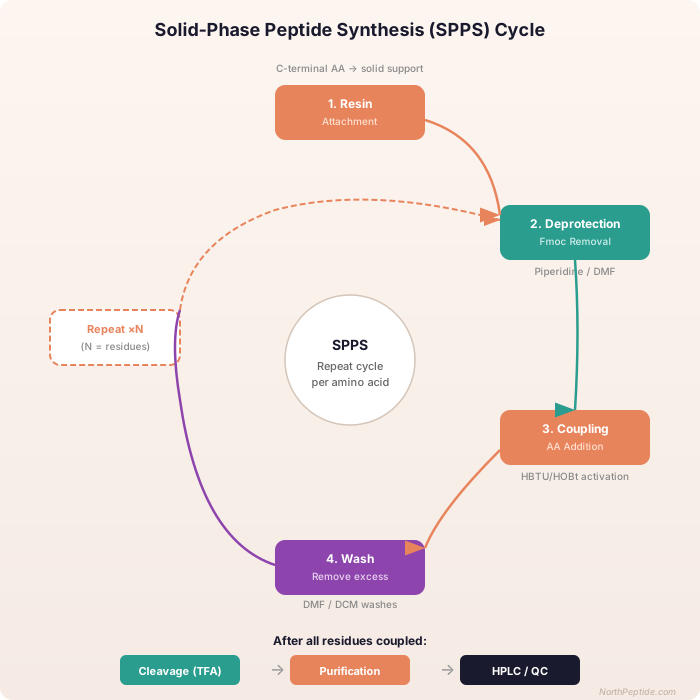
Every SPPS cycle follows the same basic sequence, repeated once for each amino acid in the target peptide. Here is how the process unfolds:
Step 1: Anchor the First Amino Acid to the Resin
The synthesis begins at the C-terminus of the peptide. The first amino acid is attached to an insoluble polymer bead (the resin) through a chemical linker. This linker is specifically designed to be stable throughout the synthesis but cleavable at the end. The amino acid's alpha-amino group is protected with a temporary protecting group to prevent it from reacting prematurely.
Step 2: Deprotection
The temporary protecting group on the alpha-amino group is removed, exposing the free amine. This makes the amino acid ready to react with the next amino acid in the sequence. The deprotection reagent and byproducts are washed away, leaving only the deprotected amino acid attached to the resin.
Step 3: Coupling
The next amino acid in the sequence, with its own alpha-amino group protected, is activated and added to the reaction vessel. The activated carboxyl group of the incoming amino acid reacts with the free amino group of the resin-bound amino acid, forming a new peptide bond. Excess amino acid and coupling reagents are washed away.
Step 4: Repeat
Steps 2 and 3 are repeated for each amino acid in the sequence, building the chain from C-terminus to N-terminus. After the final amino acid is coupled, all temporary and permanent protecting groups are removed, and the completed peptide is cleaved from the resin.
Step 5: Cleavage and Global Deprotection
The finished peptide is released from the resin using a cleavage cocktail, typically trifluoroacetic acid (TFA) for Fmoc chemistry. This step simultaneously removes the side-chain protecting groups, yielding the crude peptide in solution. The resin beads are filtered away, and the crude peptide is precipitated, usually with cold diethyl ether.
Fmoc vs. Boc: The Two Major SPPS Chemistries
Two protecting group strategies dominate SPPS, and understanding the difference between them is essential for appreciating modern peptide synthesis.
Boc Chemistry (tert-Butyloxycarbonyl)
Boc chemistry was Merrifield's original approach. The Boc group protects the alpha-amino group and is removed with trifluoroacetic acid (TFA), a moderately strong acid. Side-chain protecting groups are chosen to be stable to TFA but removable with a much stronger acid, hydrogen fluoride (HF), which is used for the final cleavage step.
Boc chemistry has some advantages: coupling efficiencies can be very high, and it works well for certain difficult sequences. However, the requirement for liquid HF in the final cleavage is a significant drawback. HF is extremely corrosive and toxic, requiring specialized equipment (a Teflon-lined HF apparatus) and rigorous safety protocols. This limitation made Boc chemistry less accessible to many laboratories.
Fmoc Chemistry (9-Fluorenylmethyloxycarbonyl)
Fmoc chemistry, developed by Louis Carpino and Geoffrey Han in 1970 and refined for SPPS by Atherton and Sheppard in the early 1980s, uses a different strategy. The Fmoc group is removed under mild basic conditions using piperidine (typically 20% in DMF), while side-chain protecting groups and the peptide-resin linkage are cleaved with TFA.
This orthogonal protection scheme, where the temporary and permanent protecting groups are removed by completely different chemical mechanisms, is a major advantage. No HF is needed at any stage, making Fmoc chemistry safer and more practical for routine use. Today, Fmoc chemistry is the dominant approach for SPPS and is used in the vast majority of commercial peptide synthesis.
Comparing the Two Approaches
| Feature | Boc Chemistry | Fmoc Chemistry |
|---|---|---|
| Alpha-amino deprotection | TFA (acid) | Piperidine (base) |
| Side-chain deprotection | HF (strong acid) | TFA (acid) |
| Final cleavage reagent | HF | TFA |
| Safety profile | Requires HF handling | No HF needed |
| Monitoring | Difficult | UV monitoring of Fmoc release |
| Automation compatibility | Good | Excellent |
| Dominance today | Niche applications | Industry standard |
Resins: The Solid Support
The "solid phase" in SPPS refers to the insoluble polymer beads to which the peptide is attached during synthesis. The choice of resin affects everything from the chemistry of the synthesis to the properties of the final product.
Polystyrene Resins
Merrifield's original resin was cross-linked polystyrene, and polystyrene-based resins remain widely used. These beads swell in organic solvents like DMF and DCM, allowing reagents to penetrate the polymer matrix and reach the growing peptide chains. Common polystyrene resins include Wang resin (for producing peptides with free C-terminal carboxylic acids) and Rink amide resin (for producing peptides with C-terminal amides).
PEG-Based and Hybrid Resins
Polyethylene glycol (PEG) based resins, such as ChemMatrix and TentaGel, offer better swelling properties in a wider range of solvents. These resins are particularly useful for synthesizing longer or more hydrophobic peptides, where aggregation on polystyrene resins can reduce coupling efficiency. PEG-polystyrene hybrid resins combine the mechanical stability of polystyrene with the improved solvation properties of PEG.
Choosing the Right Resin
The resin choice depends on the desired C-terminal functionality (acid vs. amide), the length and sequence of the peptide, and the scale of synthesis. For most standard peptide syntheses, Wang or Rink amide resins on polystyrene are sufficient. For challenging sequences, PEG-based resins may improve results.
Coupling Reagents: Forming the Peptide Bond
The peptide bond does not form spontaneously under SPPS conditions. The carboxyl group of the incoming amino acid must be activated to make it reactive enough to attack the free amino group on the resin-bound chain. This is where coupling reagents come in.
Carbodiimide Reagents (DCC, DIC)
The first generation of coupling reagents included dicyclohexylcarbodiimide (DCC) and diisopropylcarbodiimide (DIC). These reagents activate the carboxyl group by forming an O-acylisourea intermediate, which is then attacked by the amine. DIC is preferred for SPPS because its urea byproduct is soluble in DMF, making it easy to wash away.
Phosphonium and Uronium Reagents (HBTU, HATU, PyBOP)
Modern SPPS typically uses more efficient coupling reagents such as HBTU, HATU, and PyBOP. These reagents activate amino acids faster and with less racemization than carbodiimides. HATU, in particular, is considered the gold standard for difficult couplings, though it is more expensive than alternatives.
Additives (HOBt, Oxyma)
Additives like 1-hydroxybenzotriazole (HOBt) and ethyl 2-cyano-2-(hydroxyimino)acetate (Oxyma) suppress racemization during coupling. They work by converting the activated amino acid into a less reactive but more selective intermediate. Oxyma has increasingly replaced HOBt due to safety concerns (HOBt is classified as an explosive in some jurisdictions).
Why Synthesis Length Matters: The Coupling Efficiency Problem
One of the most important concepts in peptide synthesis is coupling efficiency, the percentage of chains that successfully incorporate each new amino acid. Even small shortfalls compound dramatically over the length of a peptide.
Consider a synthesis with 99% coupling efficiency per step. After 10 steps, 90.4% of the chains will be full-length product. After 30 steps, only 74.0% will be correct. After 50 steps, just 60.5% of the chains will have the right sequence. At 99.5% efficiency, the numbers improve, but the trend is the same: longer peptides inevitably contain more impurities.
| Peptide Length | 99% Efficiency | 99.5% Efficiency | 99.9% Efficiency |
|---|---|---|---|
| 10 residues | 90.4% | 95.1% | 99.0% |
| 20 residues | 81.8% | 90.5% | 98.0% |
| 30 residues | 74.0% | 86.0% | 97.0% |
| 40 residues | 66.9% | 81.8% | 96.1% |
| 50 residues | 60.5% | 77.8% | 95.1% |
This is why most commercial peptides are relatively short, typically 5 to 50 amino acids. Beyond about 50 residues, SPPS becomes increasingly impractical, and scientists turn to techniques like native chemical ligation (NCL), which joins separately synthesized peptide fragments to build longer chains.
For research peptide suppliers, coupling efficiency directly determines product purity. A well-optimized synthesis of a 30-residue peptide might yield crude material with 70-80% of the desired sequence, which is then purified by HPLC to greater than 95% or 98% purity.
Purification: From Crude to Research-Grade
After cleavage from the resin, the crude peptide contains the desired product along with deletion sequences (peptides missing one or more amino acids), truncated sequences, and various chemical byproducts. Purification is essential to produce research-grade material.
Reversed-Phase HPLC
Reversed-phase high-performance liquid chromatography (RP-HPLC) is the workhorse of peptide purification. The crude peptide is dissolved and loaded onto a column packed with C18 or C4 silica particles. A gradient of increasing organic solvent (typically acetonitrile with 0.1% TFA) elutes peptides based on their hydrophobicity. The target peptide elutes as a distinct peak, which is collected and lyophilized.
RP-HPLC can achieve remarkable separations, often resolving peptides that differ by a single amino acid deletion. For research-grade peptides, purities of greater than 95% are standard, while greater than 98% is achievable for most sequences.
Mass Spectrometry Confirmation
After purification, the peptide's identity is confirmed by mass spectrometry, typically MALDI-TOF or ESI-MS. The measured molecular weight must match the theoretical molecular weight of the target sequence. This step catches any errors in synthesis, such as incorrect amino acid incorporation or unexpected modifications.
Lyophilization
The purified peptide solution is frozen and lyophilized (freeze-dried) to produce a stable, fluffy powder. Lyophilized peptides are typically more stable than peptides in solution and can be stored at -20 degrees Celsius for extended periods. Most research peptides are supplied in lyophilized form.
Modern Advances in SPPS
While the fundamental principles of SPPS have remained unchanged since Merrifield's original work, the technology has advanced considerably.
Automation
Modern peptide synthesizers are fully automated, capable of running dozens of coupling cycles without human intervention. Automated synthesizers precisely control reagent delivery, reaction times, temperature, and washing, improving reproducibility and throughput. Some instruments can synthesize multiple peptides simultaneously using parallel synthesis techniques.
Microwave-Assisted Synthesis
Microwave irradiation during coupling and deprotection steps can dramatically accelerate SPPS. Microwave energy increases reaction rates, improves coupling efficiency (especially for difficult sequences), and can reduce total synthesis time from days to hours. Several commercial instruments combine automation with microwave heating.
Green Chemistry Approaches
Traditional SPPS uses large volumes of organic solvents, primarily DMF and DCM, which pose environmental and health concerns. Recent research has focused on developing greener alternatives, including water-based SPPS protocols, recyclable solvents, and more efficient processes that reduce solvent consumption. While these approaches are still maturing, they represent an important direction for the field.
Flow Chemistry
Flow-based peptide synthesis, where reagents are continuously pumped through a column of resin, offers advantages in speed and efficiency. Flow chemistry can complete coupling cycles in minutes rather than hours and has been used to synthesize proteins of over 100 amino acids in a single day. This approach is still primarily used in academic settings but holds promise for commercial applications.
From Synthesis to the Research Bench
Understanding how peptides are made provides important context for evaluating research materials. A research peptide that reaches a laboratory bench has typically gone through design and sequence verification, solid-phase synthesis using Fmoc chemistry, TFA cleavage and global deprotection, RP-HPLC purification, mass spectrometry identity confirmation, and lyophilization and packaging, with the quality control results written up in a certificate of analysis (COA). NorthPeptide is a distributor rather than a manufacturer or a laboratory, and does not perform any of those steps itself. Published lab results, where they exist for a compound, are listed on our test results page along with the party that commissioned each one.
A COA reports the HPLC purity, the mass spectrometry data, and other quality metrics measured on the particular sample the laboratory received. Understanding SPPS helps researchers interpret these documents and assess the quality of their research materials. For a deeper look at reading COAs, see our guide on peptide purity testing with HPLC and mass spectrometry.
Why It All Matters for Peptide Research
The quality of a research peptide is only as good as the synthesis and purification behind it. A peptide with 95% purity still contains 5% impurities, which might include deletion sequences, truncated chains, or chemically modified variants. For sensitive assays, even small amounts of impurities can confound results.
Researchers who understand the basics of SPPS can make more informed decisions about peptide quality requirements, recognize when higher purity (greater than 98%) is necessary for their application, interpret COA data and ask the right questions of suppliers, and understand why some peptides are more expensive than others (longer sequences, difficult amino acids, and higher purity all increase cost).
For more on how purity levels affect research outcomes, see our comparison of research-grade vs. pharmaceutical-grade peptides. And for a foundational understanding of the bonds that hold peptides together, explore our guide to peptide bond chemistry basics.
Summary of Key Research References
| Study | Year | Type | Focus | Reference |
|---|---|---|---|---|
| Mitchell et al. | 2008 | Historical Review | Merrifield and solid-phase peptide synthesis historical assessment | PubMed 18213693 |
| Behrendt et al. | 2016 | Review | Advances in Fmoc solid-phase peptide synthesis | PMC4745034 |
| Jaradat | 2022 | Review | Practical protocols for solid-phase peptide synthesis 4.0 | PMC9680452 |
| Mijalis et al. | 2014 | Review | Automated solid-phase peptide synthesis for therapeutic peptides | PMC4077397 |
| El-Faham & Albericio | 2011 | Review | Coupling strategies for peptide synthesis | PMC3191822 |
| Mant & Hodges | 2020 | Methods | HPLC analysis and purification of peptides | PMC7119934 |
| Jensen | 2013 | Review | Introduction to peptide synthesis | PMC3564544 |
| de la Torre & Albericio | 2023 | Review | Fundamental aspects of SPPS and green chemical peptide synthesis | PMC11985259 |
Written by NorthPeptide Research Team
Ready to explore research-grade peptides?
Research Disclaimer
For laboratory and research use only. Not for human consumption.
This article is intended solely as a summary of published scientific research. It does not constitute medical advice, treatment recommendations, or an endorsement for any therapeutic purpose. The research discussed herein is predominantly preclinical, and results may not translate to human outcomes. Researchers should consult relevant institutional review boards and regulatory guidelines before designing studies involving these compounds.
NorthPeptide supplies research-grade peptides for legitimate scientific investigation. All products are sold strictly for laboratory and research purposes.